Cordless vs Countertop
Cordless vs countertop water flosser
The question: Is a cordless or countertop water flosser better?
Countertop units hold more water and offer more pressure settings; cordless units need no outlet, travel, and many can go in the shower. An independent trial found a cordless unit matched string floss for plaque after one use.
Side by side
| Compared on | Cordless | Countertop |
|---|---|---|
| Reservoir (one maker's range) | 5 to 7 oz (150 to 210 ml): up to 30 to 45 seconds of flossing | 20 to 22 oz (600 to 650 ml): 90+ seconds |
| Pressure settings (same maker) | 2 or 3 | 10 |
| Pressure | Slightly lower overall, per the maker | Higher |
| Power | Rechargeable battery or AA batteries | Wall outlet; no charging |
| Shower use | Many are waterproof; IPX7 means rated for immersion up to 1 m for 30 minutes | No |
| Space | Stores in a drawer; no outlet needed near the sink | Needs counter space and an outlet |
| Trial evidence | Independent single-use trial with a cordless unit (83 people): equal to floss | Single-use trial with one maker's countertop unit (70 people): 29% more plaque removed than floss |
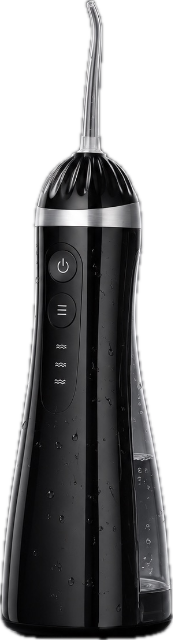
| Our option | Jet, $49, rechargeable, IPX7, interchangeable tips; reservoir size and pressure not stated yet | We don't sell one |
Where cordless wins
- No outlet or counter space needed, which suits small bathrooms and travel.
- Many are waterproof; ours is rated IPX7, so it can go in the shower.
- The independent trial we found used a cordless unit and found it as good as string floss.
Where countertop wins
- More water: 90+ seconds per fill against 30 to 45 seconds, so fewer refills mid-session.
- More control: ten pressure settings against two or three, and slightly higher pressure overall.
- No battery to charge.
Capacity and settings
In one maker's current range, cordless reservoirs hold 150 to 210 ml, enough for 30 to 45 seconds, while countertop units hold 600 to 650 ml for 90+ seconds. Cordless models offer two or three pressure settings and countertop models ten. The maker describes cordless units as having a smaller reservoir and slightly lower water pressure.
Does pressure matter?
A 2026 study in 12 people used 3D-printed guides to hold a water jet at fixed settings and found water pressure had the largest effect of the three factors tested, with the best result at 90 psi among 70, 80 and 90 psi. It is a lab-style setup, not home use, but it suggests pressure is worth knowing. Our Jet's pressure isn't in our listing yet; we'll publish it once measured.
What the trials used
The 2013 trial that found a water flosser removed 29% more plaque than floss used a countertop unit filled with 500 ml of warm water, more than any cordless reservoir in the range we read. The 2021 trial that found the two equal used a cordless unit. Both were single-use plaque studies.
Which to pick
If you have counter space and an outlet by the sink and want the most settings, countertop. If you travel, share a small bathroom, or want to floss in the shower, cordless. Either way, the ADA's advice is to clean between your teeth once a day; people with braces, bridges or other dental work may find a water flosser helps.
On our shelf
Read next
Comparison
Copper vs stainless steel tongue scraperIs a copper or stainless steel tongue scraper better?Reviewed November 17, 2026Comparison
Water flosser vs string flossIs a water flosser better than string floss?Reviewed November 17, 2026Comparison
Stainless steel vs jade gua shaIs a stainless steel or jade gua sha better?Reviewed November 17, 2026Comparison
Walking pad vs treadmillShould you get a walking pad or a treadmill?Reviewed November 17, 2026Comparison
Red vs amber night light for sleepIs a red or amber night light better for sleep?Reviewed November 17, 2026Comparison
Light therapy lamp vs sunrise alarm clockIs a light therapy lamp or a sunrise alarm clock better?Reviewed November 17, 2026Sources
- Water flosser manufacturer buying guide: cordless models (specs read 2026-11-17)
- Water flosser manufacturer buying guide: countertop models (specs read 2026-11-17)
- DLS Electronic Systems (test lab): IPX7 and IPX8 immersion testing under IEC 60529
- Guo et al., BMC Oral Health 2026: water jet pressure, nozzle and distance vs plaque removal, 12 people (PubMed abstract)
- Goyal et al., J Clin Dent 2013: water flosser vs string floss, single use, 70 adults (PubMed abstract)
- Abdellatif et al., Saudi Dent J 2021: cordless water flosser vs floss, 83 people (PubMed abstract)
- American Dental Association, MouthHealthy: Flossing
Corrections
See something wrong, or a study we read differently than you? Write to hello@outwill.shop. A person checks it, corrects the page and updates the review date. How we grade and review.