How to use
How to use a water flosser
The question: Should you use a water flosser before or after brushing?
Either works: the ADA says it doesn't matter when you floss as long as you do it thoroughly, once a day. One small trial with string floss found flossing before brushing removed more plaque between teeth, so we suggest before.
Step by step
Once a day
The ADA recommends cleaning between your teeth once a day.
Before brushing
The ADA says the order doesn't matter. In a 2018 crossover trial of 25 dental students using string floss, flossing first removed more plaque between teeth and left more fluoride there. It hasn't been tested with a water flosser.
Fill with warm water and lean over the sink
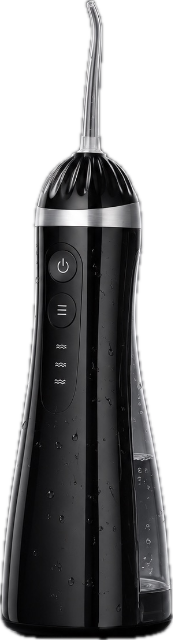
The maker's instructions: fill the reservoir with warm water, click in a tip, lean over the sink and let water flow from your mouth into the sink.
Aim at the gumline, pause between teeth
Aim the tip along the gumline and pause between teeth, front and back sides. That is the maker's method and our instruction for the Jet.
Change the tip every three months
Our schedule for Jet tips.
Common mistakes
- Treating it as a replacement for dental visits. The ADA says to see your dentist regularly.
- Doing it some days and not others. The ADA advice is daily.
- Assuming it beats floss. Trials are mixed: one maker-run trial found more plaque removed, an independent trial with a cordless unit found no difference.
The free version
String floss, once a day. The ADA recommends cleaning between your teeth daily, and floss has the most trials behind it.
Ask your dentist if
You have braces, bridges, implants or other dental work. The ADA says people with dental work may find a water flosser helps them reach every nook and cranny; your dentist can tell you what fits your mouth.
What the evidence says
A 2019 Cochrane review rated the evidence for water flossers low to very low certainty: they may reduce gum inflammation at one month but showed no plaque difference against floss. Single-use trials split: 74% vs 58% plaque reduction in a trial of one maker's countertop unit, and 87% vs 89% (no difference) in an independent trial with a cordless unit.
On our shelf
Read next
Method
Water flossingIs a water flosser better than floss?Reviewed November 17, 2026Study
Water flosser vs string floss after one use: a 2013 trialWhat did the 2013 single-use water flosser vs string floss trial find?Reviewed November 17, 2026Study
Floss, brushes and water flossers: a 2019 Cochrane reviewWhat does the Cochrane review say about water flossers and floss?Reviewed November 17, 2026Guide
How to choose a water flosserWhat should you look for in a water flosser?Reviewed November 17, 2026Comparison
Water flosser vs string flossIs a water flosser better than string floss?Reviewed November 17, 2026Comparison
Cordless vs countertop water flosserIs a cordless or countertop water flosser better?Reviewed November 17, 2026Sources
- American Dental Association, MouthHealthy: Flossing
- Mazhari et al., J Periodontol 2018: floss before or after brushing, crossover, 25 dental students (PubMed abstract)
- Water flosser manufacturer: how to water floss
- Goyal et al., J Clin Dent 2013: water flosser vs string floss, single use, 70 adults (PubMed abstract)
- Abdellatif et al., Saudi Dent J 2021: cordless water flosser vs floss, 83 people (PubMed abstract)
- Worthington et al., Cochrane Review 2019: home interdental cleaning devices, 35 trials (PubMed abstract)
Corrections
See something wrong, or a study we read differently than you? Write to hello@outwill.shop. A person checks it, corrects the page and updates the review date. How we grade and review.