How to choose
How to choose a walking pad
The question: What should you look for in a walking pad for a desk?
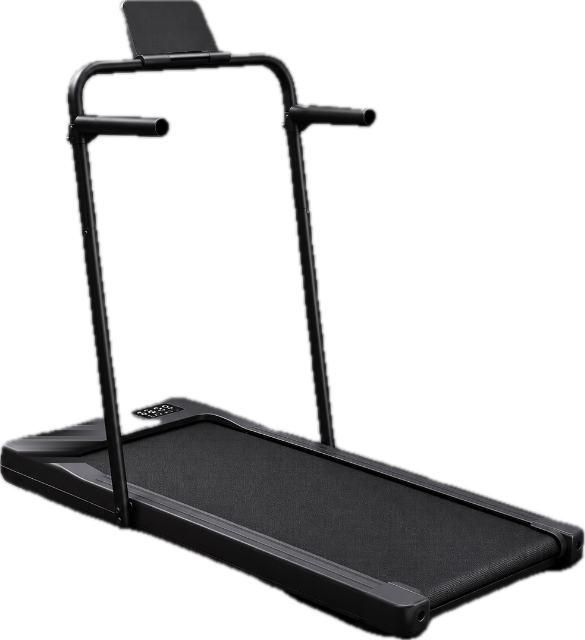
A low, steady speed range (desk typing works best around 1 to 1.5 mph), a weight limit well above your weight, a motor rating that says continuous duty, and a belt that fits your stride. Noise and belt size matter but are rarely stated; ask.
The numbers that matter
- Speed range
- Typing matched seated typing at about 1.4 mph in a 2012 study; office workers chose about 1.1 mph. Most pads top out around 5 mph (Cleveland Clinic). Desk Walker: 0.6 to 3.8 mph.
- Incline
- Most walking pads have no adjustable incline (Cleveland Clinic). For training, ACE suggests 10 to 15% on a treadmill. Desk Walker: 6%.
- Motor (HP)
- ACE: look for at least 2.0 continuous-duty horsepower for users over 180 lb, and check whether the rating is continuous or peak. Desk Walker: 2.5 HP; rating type not stated in our listing.
- Weight limit
- ACE notes that going over a machine's weight spec can void its warranty. Desk Walker: 300 lb.
- Belt size
- ACE's 2013 minimum for a full treadmill is 17 by 49 inches. Desk Walker: belt size not stated in our listing.
- Noise
- There's no standard noise figure for walking pads; ACE's advice is to ask whether the machine is loud. Desk Walker: not measured yet.
- Weight and storage
- Cleveland Clinic puts walking pads at about 30 to 50 lb. Desk Walker: folding handle, rolls under a bed or desk; unit weight not stated.
- Warranty
- ACE: component warranties typically ran 90 days to three years in 2013. Desk Walker: 1-year warranty on devices.
Before you buy
Measure the space under your desk and wear the shoes you'll walk in. If you are over 50 and not used to exercise, or have dizziness or trouble with balance, talk to your doctor first (American Academy of Family Physicians); most walking pads have no handrails.
Counting what it does
Step counters lose accuracy at slow speeds: about 40% average error between 0.5 and 2 mph across 21 devices in a 2022 study, with wrist devices the least accurate. Count steps with a phone in your pocket or a hip or ankle counter.
On our shelf
Read next
Method
Daily stepsHow many steps a day do you need?Reviewed November 17, 2026Study
Daily steps and risk of death: a 2022 meta-analysis of 15 cohortsWhat did the 2022 Lancet meta-analysis of daily steps find?Reviewed November 17, 2026Guide
How to use a walking pad at your deskWhat speed should a walking pad be for desk work?Reviewed November 17, 2026Comparison
Walking pad vs treadmillShould you get a walking pad or a treadmill?Reviewed November 17, 2026Guide
How to use a light therapy lampWhat time should you use a light therapy lamp, and for how long?Reviewed November 17, 2026Guide
How to use a red light maskHow often should you use a red light mask?Reviewed November 17, 2026Sources
- Funk et al., Percept Mot Skills 2012: treadmill walking speed and typing, 24 people (PubMed abstract)
- Levine and Miller, Br J Sports Med 2007: walk-and-work desk, self-selected speed, 15 office workers (PubMed abstract)
- Cleveland Clinic: Are walking pads worth it?
- American Council on Exercise, Fit Facts 2013: What you need to know to purchase a treadmill (PDF)
- Mora-Gonzalez et al., Int J Behav Nutr Phys Act 2022: accuracy of 21 step counters across treadmill speeds, 258 adults (PubMed abstract)
- American Academy of Family Physicians, familydoctor.org: Exercise and seniors
Corrections
See something wrong, or a study we read differently than you? Write to hello@outwill.shop. A person checks it, corrects the page and updates the review date. How we grade and review.