Method
Evening light and melatonin
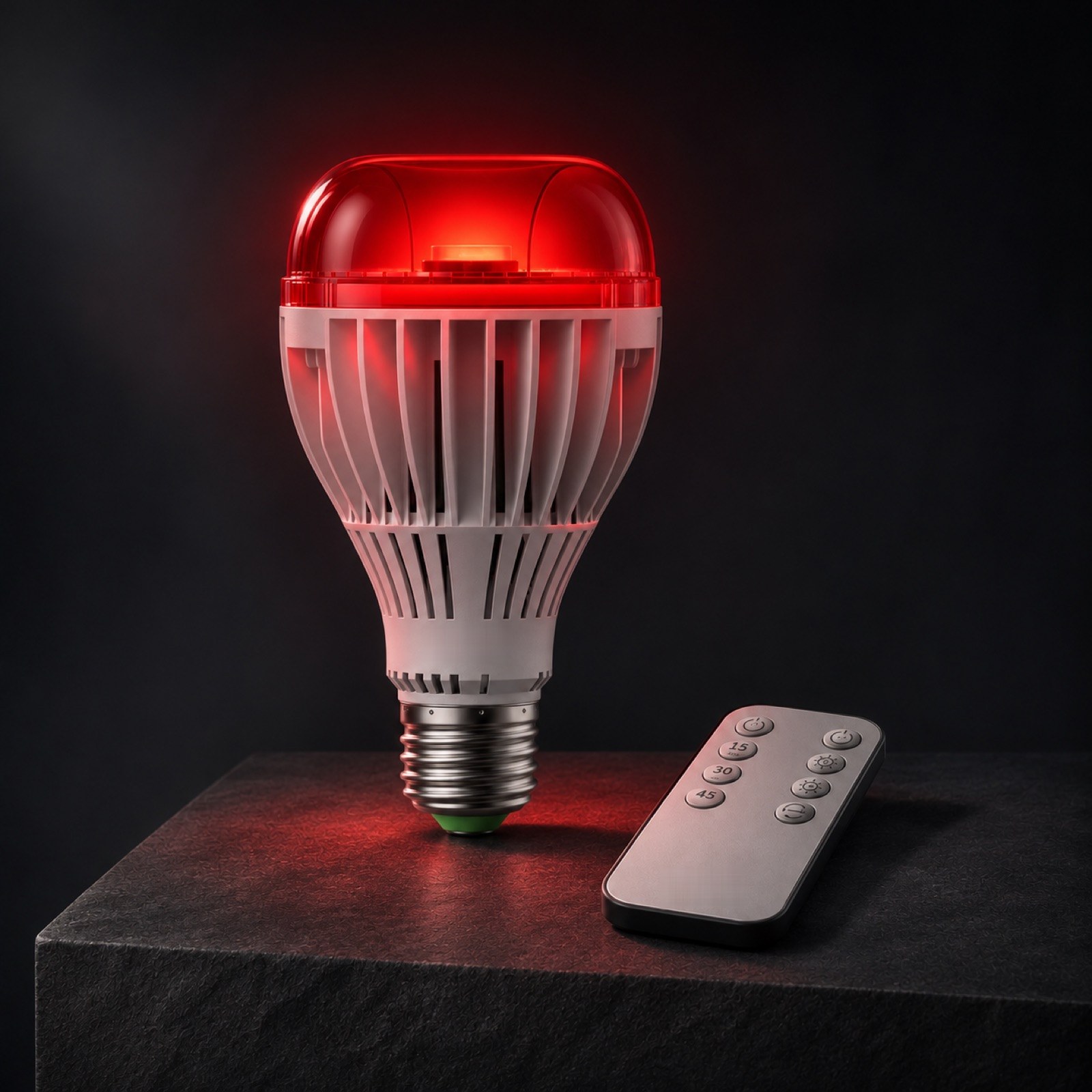
The question: Does a red light bulb help sleep?
No study we read tested a red bulb on sleep. What we read shows that ordinary room light before bed shortened melatonin duration by about 90 minutes, and that blue light (446–477 nm) suppresses melatonin most, which is the reasoning behind dim, deep-red evening light.
Our grade: Plausible
Built on a well-supported mechanism; the product itself is not trialled.
The mechanism is well supported. Gooley 2011 showed that room light before bed delayed melatonin onset in 103 of 104 young adults. Brainard 2001 showed melatonin is most sensitive to blue light. Neither study tested light above 600 nm or measured sleep, and we have not read a trial of red bulbs and sleep. That is why this is plausible, not proven.
A grade describes the research behind a method. It is not a score for a product and not a promise. How we grade.
What the trials used
| Study | Dose | Duration | Result |
|---|---|---|---|
| Gooley JJ 2011 | Under 200 lux white room light vs under 3 lux | 8 hours before bed | Melatonin duration 8 h 45 min vs 10 h 17 min |
| Brainard GC 2001 | Single colours from 420 to 600 nm, at least 7 intensities each | Night exposures between 2:00 and 3:30 am | Strongest suppression at 446–477 nm |
Talk to a doctor first if
- Trouble sleeping for months, or sleep problems that make daily life hard to cope with: see a GP or doctor (NHS).
- A dim bulb is not a treatment for insomnia or any sleep disorder.
Still open
- How much 670 nm light suppresses melatonin at bedside brightness.
- Whether switching to red evening light changes sleep, not just melatonin.
- How screens compare with room lighting at home.
The studies, one page each
Sources
- Gooley JJ, Chamberlain K, Smith KA, Khalsa SB, Rajaratnam SM, Van Reen E, Zeitzer JM, Czeisler CA, Lockley SW (2011), Journal of Clinical Endocrinology & Metabolism
- Brainard GC, Hanifin JP, Greeson JM, Byrne B, Glickman G, Gerner E, Rollag MD (2001), Journal of Neuroscience
- NHS: Insomnia
- Gooley et al., J Clin Endocrinol Metab 2011 (full text)
- Brainard et al., J Neurosci 2001 (PubMed)
Corrections
See something wrong, or a study we read differently than you? Write to hello@outwill.shop. A person checks it, corrects the page and updates the review date. How we grade and review.