Study · Sleep, 2023
Eye masks, next-day learning and alertness: a 2023 study
The question: Does wearing an eye mask at night improve learning and alertness?
In two within-person experiments with young adults (89 and 33 analysed), a week with a light-blocking mask gave slightly better word-pair learning and reaction times than a week without. The effects were small (d about 0.2), self-rated sleep quality did not change, and a reanalysis found the learning effect no longer significant.
The paper
Greco V, Bergamo D, Cuoccio P, Konkoly KR, Muñoz Lombardo K, Lewis PA (2023). Wearing an eye mask during overnight sleep improves episodic learning and alertness. Sleep.
Read it at the source · DOI 10.1093/sleep/zsac305 · PubMed
We read the full paper.
Who was studied, and how
- Design
- Two within-subject experiments at home in counterbalanced order: a week with an eye mask vs a week with no mask (2018) or with a mask that had holes cut over the eyes (2019 and 2020). Published online December 2022, in print March 2023.
- Participants
- Experiment 1: 94 enrolled, 89 analysed. Experiment 2: 37 enrolled, 33 analysed (sleep data from 29).
- Population
- Healthy 18–35-year-olds in Cardiff (UK) and Italy with no sleep disorders, who had never slept in an eye mask. Studied in summer with curtains open.
What the trial used
- Mask
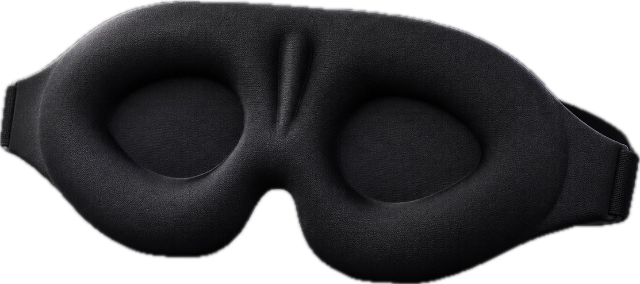
- Light-blocking eye mask every night; control was no mask or a mask with eye holes
- Experiment 1
- 5 nights, then 2 test days, per condition
- Experiment 2
- 2 nights, then 2 test days, per condition
- Tests
- Word-pair learning, reaction time (psychomotor vigilance), motor-skill learning
- Sleep tracking
- Dreem EEG headband in Experiment 2
- Season
- Late June to September, when dawn is early
What it found
Next-day word-pair learning, reaction time, motor-skill learning, self-rated sleepiness and sleep quality, and sleep stages in Experiment 2.
- Effect, as reported
- Experiment 1: 65.06 vs 63.87 word-pair score (d=0.19); reaction time 310.26 vs 316.37 ms (d=0.16). Experiment 2: 69.9 vs 67.7 (d=0.22). No change in motor learning, self-rated alertness, hours slept, self-rated sleep quality or sleep stages.
Limitations
- Small effects: roughly 1 to 2 extra word pairs out of 80 and about 6 ms faster reactions.
- A 2023 reanalysis (Rhodes, Sleep) found the Experiment 1 learning effect not significant (p=0.053) once person-to-person variation was modelled; the reaction-time effect stayed just significant (p=0.047).
- Participants could not be blind to wearing a mask.
- Young healthy adults sleeping with curtains open in summer, which may not match a dark bedroom.
- In 2018 the control condition was no mask at all.
Funding and conflicts
Supported by European Research Council grant SolutionSleep (681607) to P.A. Lewis. Financial and non-financial disclosures: none declared.
What it does not show
- That a mask helps you fall asleep faster or sleep longer. Hours slept and self-rated quality did not change.
- Any effect in people with insomnia or other sleep problems.
- Anything about contoured masks specifically.
- Effects beyond one week.
The trial, not our unit
This study tested a method with the researchers' own equipment. It did not test any OUTWILL product. Each product page sets what the trial used beside what you get, and marks where they differ.
On our shelf
Read next
Sources
Corrections
See something wrong, or a study we read differently than you? Write to hello@outwill.shop. A person checks it, corrects the page and updates the review date. How we grade and review.